
Bridging creative vision with contemporary architectural tools — a curated selection of work across conceptual design, AI visualization, and computational research.
Constructing and evolving geometric systems within Grasshopper, then refining them through fine-tuned AI models. This workflow bridges algorithmic generation with intelligent visual interpretation, producing architectural forms that exceed conventional design methods.
Transforming 3D architectural models into richly rendered AI outputs — bridging the gap between computational modeling and photorealistic visualization through intelligent image synthesis.
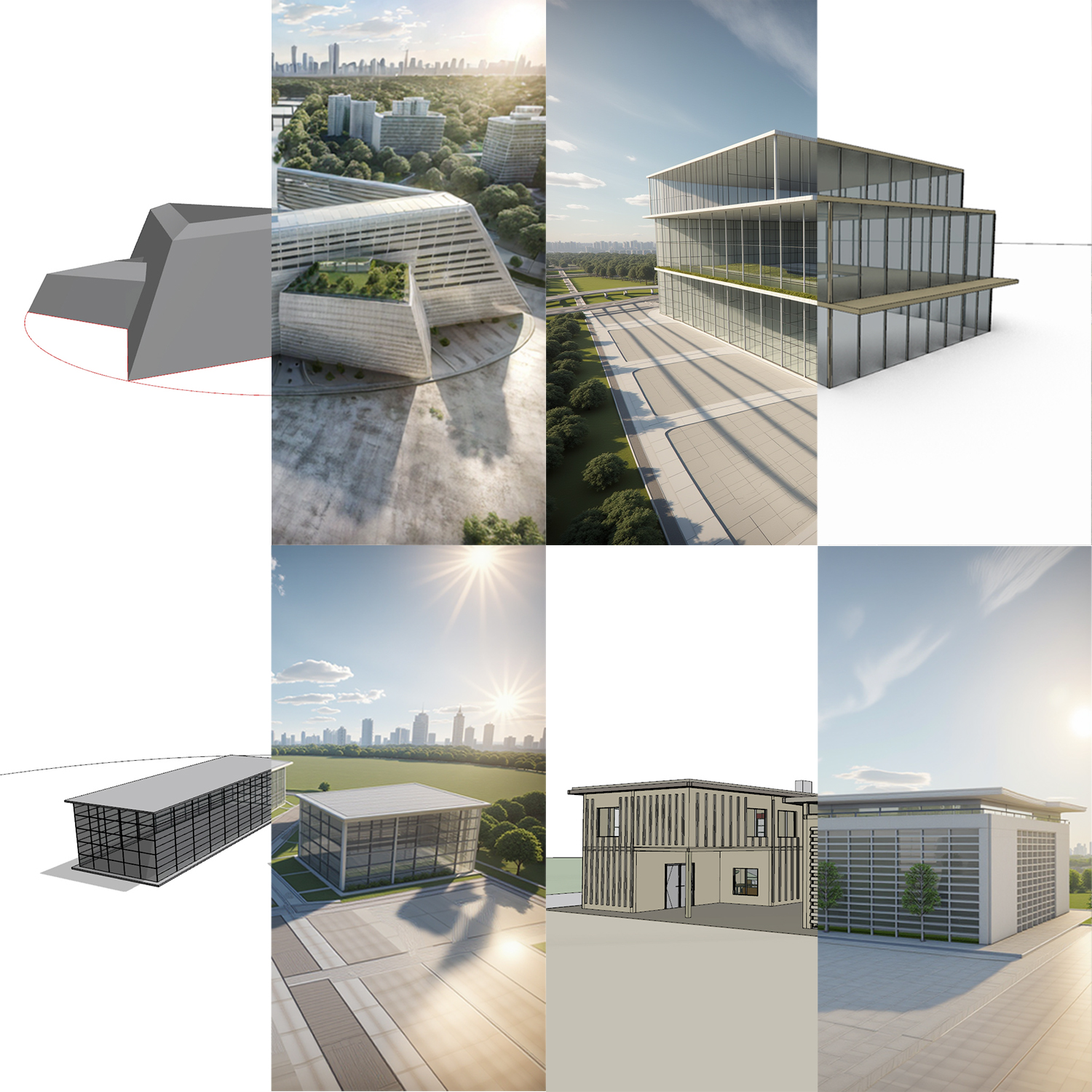
Integrating AI-powered real-time rendering directly within the computational design process — enabling dynamic visual feedback during form exploration and igniting deeper conceptual studies.
A generative reinterpretation of the traditional mashrabia screen — recasting this centuries-old Arabic architectural element through computational patterning and AI-driven concept visualization. The result explores how heritage geometries can be translated into contemporary spatial experiences.
An exploration of fluid geometry as a structural and spatial driver — tracing continuous parametric lines that evolve from tectonic logic into organic architectural form. Produced within Grasshopper and rendered through AI synthesis workflows.
A study of the architectural grid as both structure and surface — using parametric manipulation to push a fundamental ordering system toward spatial complexity, material depth, and perceptual richness.
Multiple flow fields layered and intersected to produce emergent surface geometries — an investigation into how simple rule-based systems generate spatially complex, atmospheric architectural forms.
Investigating the intersection of computational ornamentation and architectural envelope design — generating patterned facade systems that encode cultural, structural, and environmental logic through parametric repetition and variation.
A computational approach to sacred space — exploring how tectonic rhythm, structural repetition, and light modulation can define the spatial character of a mosque typology. Geometry and spirituality converge through algorithmic form-finding and AI concept visualization.